
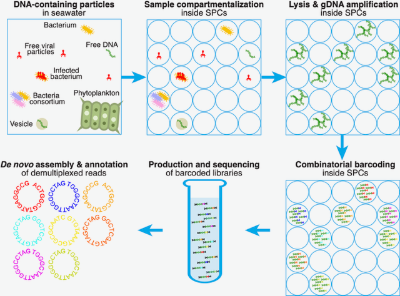
Viruses and other extracellular genetic elements play essential roles in marine microbial communities. However, methods to capture their full diversity remain limited by the constraints of bulk sequencing assemblers or pre-sorting throughput. Here, we introduce environmental micro-compartment genomics (EMCG), which vastly improves the throughput and efficiency of single-particle genomic sequencing from nanoliter volumes by compartmentalizing sample particles into picolitre-sized, semi-permeable capsules for in-capsule DNA amplification and barcoding. From 300 nanoliters of seawater, EMCG obtained genomic sequences of 2,037 particles. The microbiome composition agreed with other methods, and the virus-like assembly lengths indicated that most were near-complete. Many viral assemblies belonged to the Naomiviridae, lacked metagenomic representation, and aligned to outlier contigs of abundant, putative host lineages, suggesting their use of non-canonical DNA and overlooked ecological importance. This approach provides opportunities for high-throughput, quantitative, and cost-effective genome analyses of individual cells and extracellular particles across complex microbiomes.
Read the whole article in Nature Microbiology